Cobra lillies (Darlingtonia californica) are one of my favourite plants – not that you’d know it at the moment given I mainly post about Sarracenia flava. But if you look back through this blog, you’ll see I used to grow it to a reasonable size (at least by Australian standards) until I lost my plants during hot, still weather soon after we moved house. I’ve tried it a few times since (including in my bog gardens) and lost it each time. When the AUSCPS meetings started up here in Canberra, I brought some to try a few ideas on how to grow it here.
The first two attempts failed because a bird (magpie?) uprooted the plant and dropped it on hot concrete while we out, and the second because the plant was not watered while I was away with work.
The third time seems the charm – I managed to get the plant through the first batch of hot weather (including 11 days straight above 35C and nights above 20C). I did this by keeping the plant in a ventilated site in the shade. That said, it looked very miserable.
My experience with Darlingtonia is that they like an open and airy mix in a broad, shallow tray that is regularly flushed with water, with the plants kept in a shady and breezy (but not windy) position. The plants I got recently were all in a standard height unglazed terracotta pot in 1:1 peat: sand media with Sphagnum top dressing, which I felt was not open enough based on how slowly it drained if wetted (the smell of the media at the bottom of the pot also told me the conditions were anaerobic and thus stagnant).
After the Christmas heat wave, I repotted the last remaining plant into a very coarse mix of 1:1 scoria: Sphagnum, which has worked well for me previously. A note in preparing this mix – it is important that the moss strands are completely separated, as they tend to form clumps or balls that don’t mix evenly with the scoria. I try to mix it by layering spread strands of Sphagnum across the pot and then covering it one stone deep with scoria and repeating.
Here is the result:
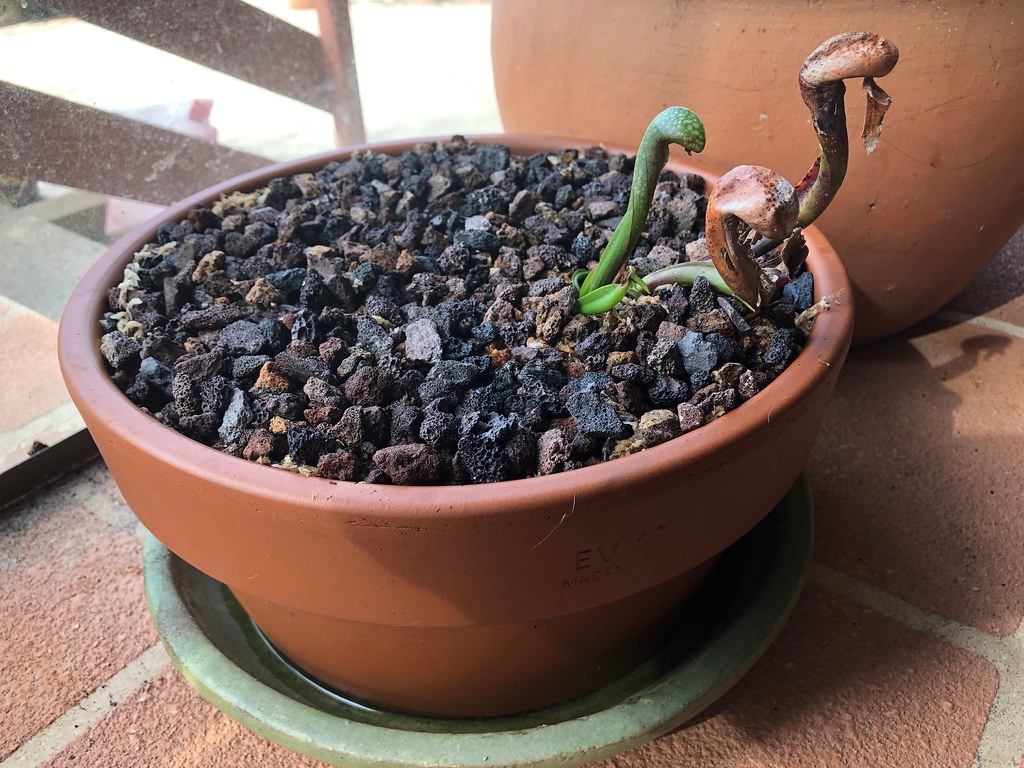
The plant is clearly not happy given previous treatment – but it had a good, healthy root and rhizome system, so its capable of trying. The new mix drains very quickly, which is a good thing for keeping the medium aerated, while the Sphagnum holds a lot of moisture. The trick will be to flush it out with water every day to keep the moisture up to allow evaporative cooling across the terracotta. I think shallow Terracotta planter bowls work well because they have a larger surface area than a tall pot (if you consider the surface area of the top of the pot as well), which maximises cooling and aeration potential. Not sitting the pot in a deep tray of water also forces water to evaporate from the sides of the pot. I have this plant next to the door of our sunroom where it gets bright, indirect light and a good breeze blowing across it most of the day to help keep it cool. Despite an air temperature of 28C this afternoon, the pot was almost cold to the touch, so it seems to be working.
Here’s hoping!
Postscript – this approach seems to work – if you keep the saucer full of water! The plant romped through 10 days with maximums above 36C and even a full week of maximums above 40C. It sadly didn’t survive not being watered by the designated waterer while I was away in February, so it dried to a crisp.


