Recently, I noticed that people all over the world are growing a plant called
Drosera peltata var.
gracilis, 'alpine form, Tuggeranong, ACT'. This amuses me, because I actually live in the Tuggeranong Valley of the Australian Capital Territory (or ACT). As it turns out, I live only a few kilometers from the place where the Tuggeranong plants originated. Access to the site is relatively easy - I only had to walk some 1500 meters through a pine forest and I was at the site.
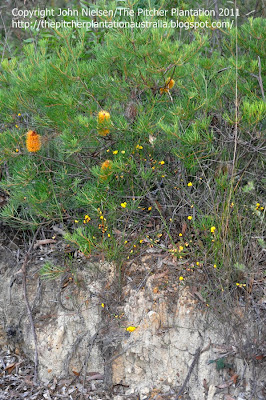
The first thing that struk me about the habitat was its small size - the plants mainly occur in a roadside seep less than 10 meters square! I am not sure whether or not the seep is spring fed - someone told me it was only rain fed - but it is wet enough to allow a variety of bog plants to grow.
It is also important to note that this site is not alpine - the seep is only 750 meters above sea level. It is on the western flanks of a hill and gets full exposure to the hot summer sun. Like my place a few kilometers away, it gets hot and dry here - it will likely get hotter than 35*C (95*F) here at least one day every summer, with 29*C the average maximum (85*F). Humidity on these days averages around 30% at 3 PM - this is comparable to 3 PM humidity in the Sahara desert! In winter, frosts are common but snow rare - it might snow here once a year, but it never gets cold enough for the snow to form drifts or even last long on the ground.
Both
D. peltata and
D. auriculata occur here. Growth varies year to year with rainfall - plants can come up quickly once it is wet, but can quickly be set back if it then dries out. This year, we had a wet spring and early summer, so the plants grew quickly. But it then became very dry for a few weeks, so the plants were visibly set back when I visited. But it did rain a few weeks earlier, so there were lots of seedlings growing, taking advantage of the wet. Some older plants showed signs of a second growth spurt as well.
Most of the
D. aurculata also grew in the more open, grassy areas of the seep, with the
D. peltata mainly growing under
Kunzea shrubs. I am not sure what altitude
D. auriculata grows to in the ACT, but I have seen
D. peltata growing right up to 1400 meters in Corin forest. In this area, I have found
D. peltata growing in what seems to be a permanant seep on the side of a hill at Smoker's Gap (photo at left; note clump of
Sphagnum cristatum at top center). The plants themselves again occur in a relatively small area here. It is very easy to overlook them because of the amount of grasses and herbs they grow with. Their leaves also tend to be rather small and few traps are active at any one time - most have already become exhausted from prey capture.
Drosera peltata var. gracilis at Smoker's Gap, ca. 1400 meters elevation.
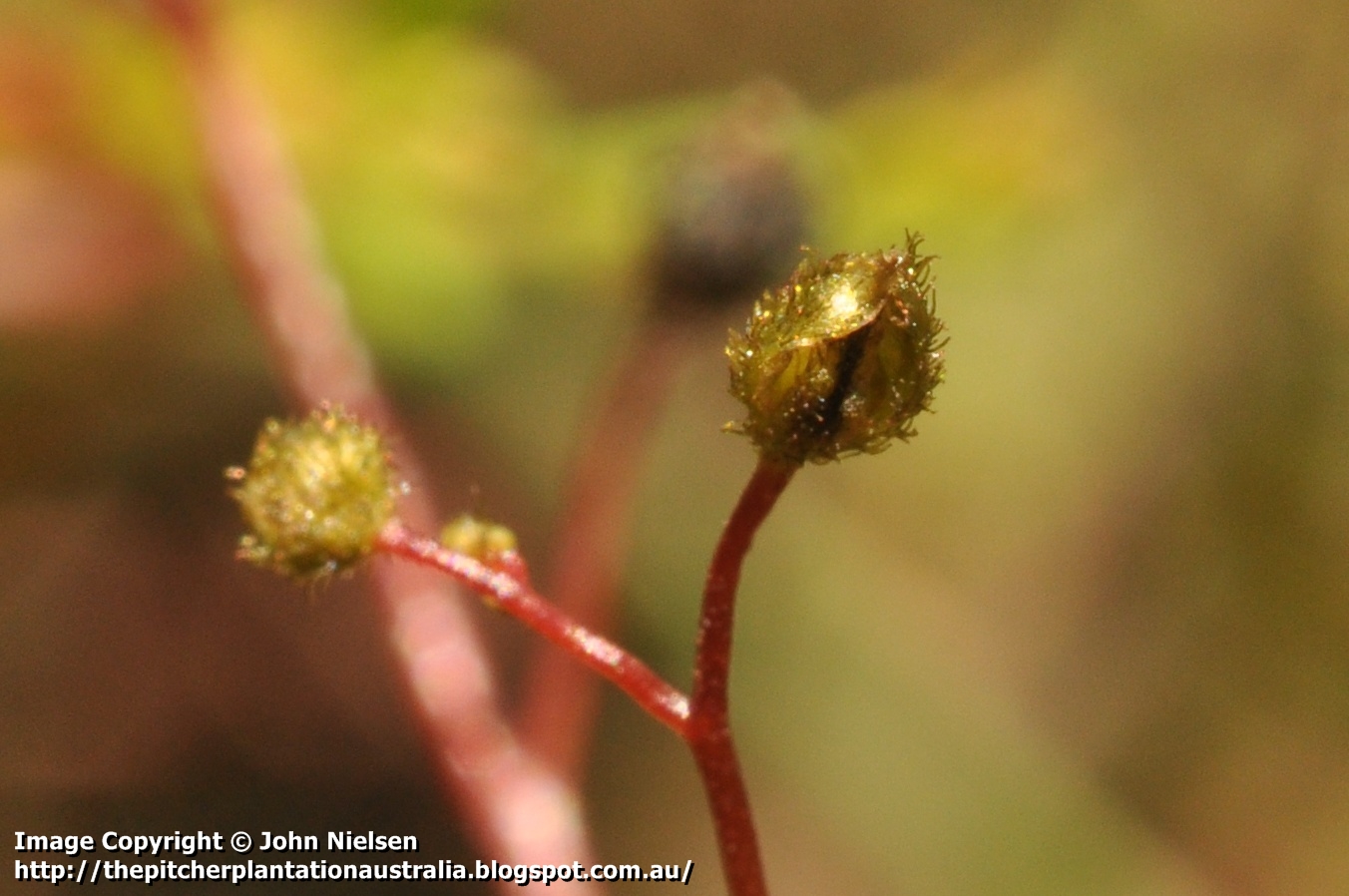
The photo below shows an important diagnostic feature for
Drosera peltata that is useful in separating it from
D. auriculata in many cases. Note the fuzzy or hairy appearance of the sepals? The fuzzyness is caused by trichomes that are present, for the most part, only in
D. peltata and not in
D. auriculata.
Also present here are
Utricularia dichotoma and
Sphagnum cristatum. This area is sub-alpine, dominated by snow gum open forest and grasslands. It also gets a genuinely cold winter, with periods of snow on the ground and many days of frost.
Utricularia dichotoma flowers at Smoker's Gap, 1400 meters.
I am reasonably confidant that both
Drosera will also occur much higher up. I am also hopeful that another, as yet unrecorded species for the ACT region (
D. arcturi) will occur there as well. Hopefully, I'll have a chance to get up into the mountains in coming weeks. I tried to yesterday, but a severe thunderstorm hit just as we got to where the
D. peltata grow. We turned around when 2-3 cm (1") hail started falling - I had no intention of ruining my car! We got home just as the storm hit the Tuggeranong area, but only pea hail fell here.
**Update from 24 April 2011***
I took a quick trip up to the high alpine in the Brindabellas and walked down to the
Sphagnum cristatum heath at the foot of Mount Ginini. I had hoped to find
Drosera arcturi here, but the habitat is entirely different to where I have seen
D. arcuturi in Tasmania. Instead of open, low heath (tarns), the Ginini wetlands are comprised of dense
Sphagnum hummocks (many of which were killed in the 2003 bushfires) and dense heath vegetation up to 1 meter in height. I have not given up on finding
D. arcturi there yet, but it will take a lot of fieldwork next season to be sure if it is not there.