Showing posts with label ampullaria. Show all posts

Monday, April 22, 2019

Autumn 2019 roundup – its been hot, hot, hot!

Last time I blogged, it was quarter of a year ago and midsummer. The flava were just finishing up, and I was making a Drosera schizandra terrarium.

So then what happened?

It got hot. Seriously hot! And it stayed hot well into March, with April also being hotter than normal, but bearable. In late January, we had 10 days of maximums not below 36°C (most of the week was above 40°C!) with windy conditions, and this set everything back very badly (even though we kept water up to everything). By this time next week, we will have had our first real frosts, with the weekend set to get 1°C minimums, so autumn has been very truncated.

Autumn pitchers of Sarracenia leucophylla, 2018-19 season. Autumn pitchers of Sarracenia leucophylla, 2018-19 season. Autumn pitchers of Sarracenia leucophylla, 2018-19 season. Autumn pitchers of Sarracenia leucophylla, 2018-19 season.Autumn pitchers of Sarracenia leucophylla, 2018-19 season. Autumn pitchers of Sarracenia leucophylla, 2018-19 season. Autumn pitchers of Sarracenia leucophylla, 2018-19 season. Autumn pitchers of Sarracenia leucophylla, 2018-19 season.

As a result, no-one in Canberra had decent pitchers from their autumn Sarracenia (i.e. Sarracenia leucophylla and S. rubra), with the pitchers arriving in early April. Most of the pitchers we did get were tiny. I managed to get a few half-decent ones (see above), but nothing like previous years. The pitchers above are close-ups, they are not very big at all.

I’m thinking it may be a safer bet to stay with the spring peaking species like S. flava

Drosera prolifera Drosera prolifera terrarium

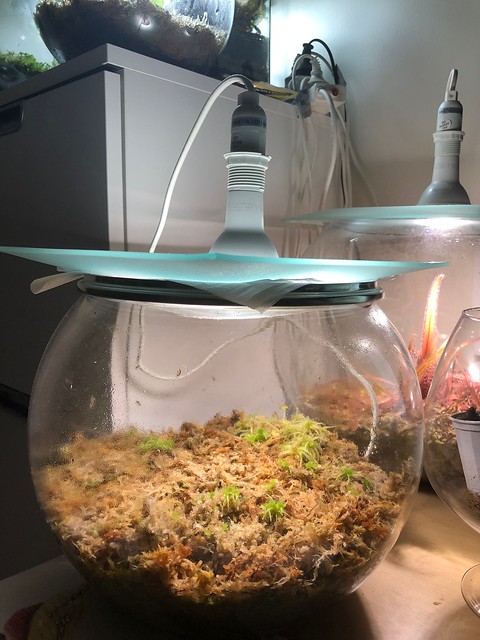
On the plus side, I managed to get the trifecta of Drosera Section Prolifera in the collection and growing successfully. The last addition was a D. prolifera via AUSCPS Canberra coordinator Barry (thanks Barry!). Its been going strong for about two months now and is putting up several leaves a week. So far, its still one plant, but I’m hoping it will be in flower by the end of winter and busily proliferating across its bowl. The setup is a slightly smaller glass bowl than the D. adelae, with a glass saucepan lid on top. I diffused the light from a 7W Vaxer lamp using a sheet of plastic foam paper (the type that manufacturers use to protect appliances when you buy them) folded into 4 layers) and a sintered glass plate, with the lamp on top.
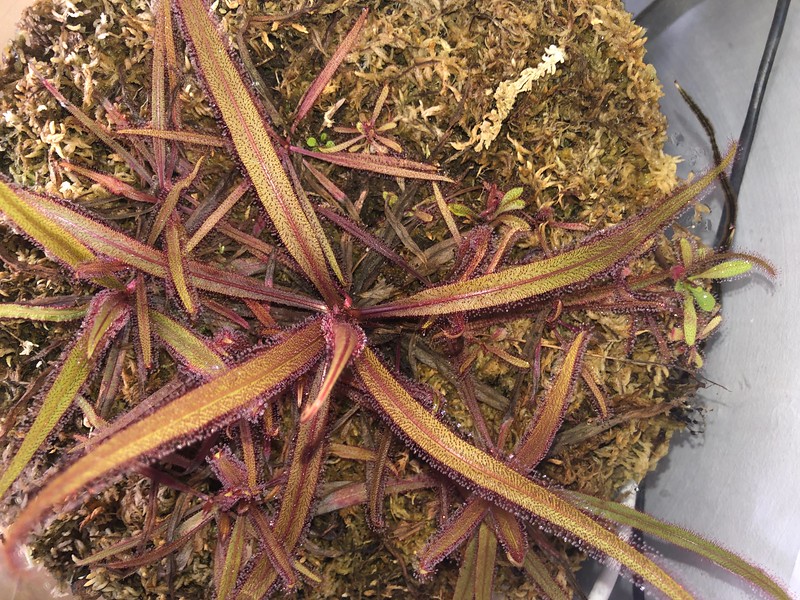
Drosera adelae terrarium

The D. adelae is also going very well, with its roots now reaching all around the bowl. There should be a huge number of pups coming up soon (guaranteed if I help by taking to the bowl with a pair of scissors!). The parent plant, which was at death’s door at the end of last winter, is now about 400 mm across! Impressive!
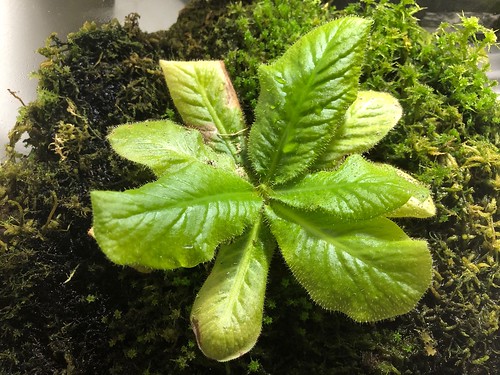
Drosera schizandra Drosera schizandra

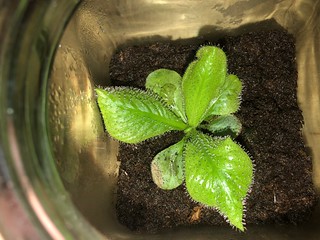
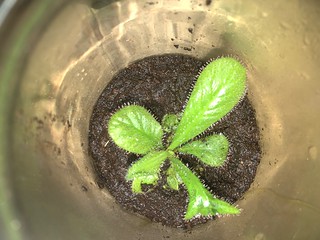
The D. schizandra terrariums have been a lot more hit and miss. The first one I set up (left) was inadvertently put in a spot where it got a hour or so of full sun daily, which set it back. Fortunately, they give you some warning before they die, so I managed to catch it and fix it up in a new spot. However, a second terrarium that was positioned better has done well, with the plant not missing a beat – its been glistening in dew continuously from when it was re-potted.

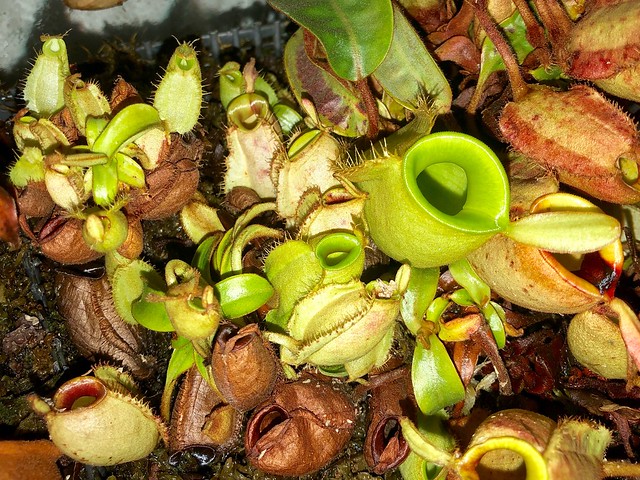
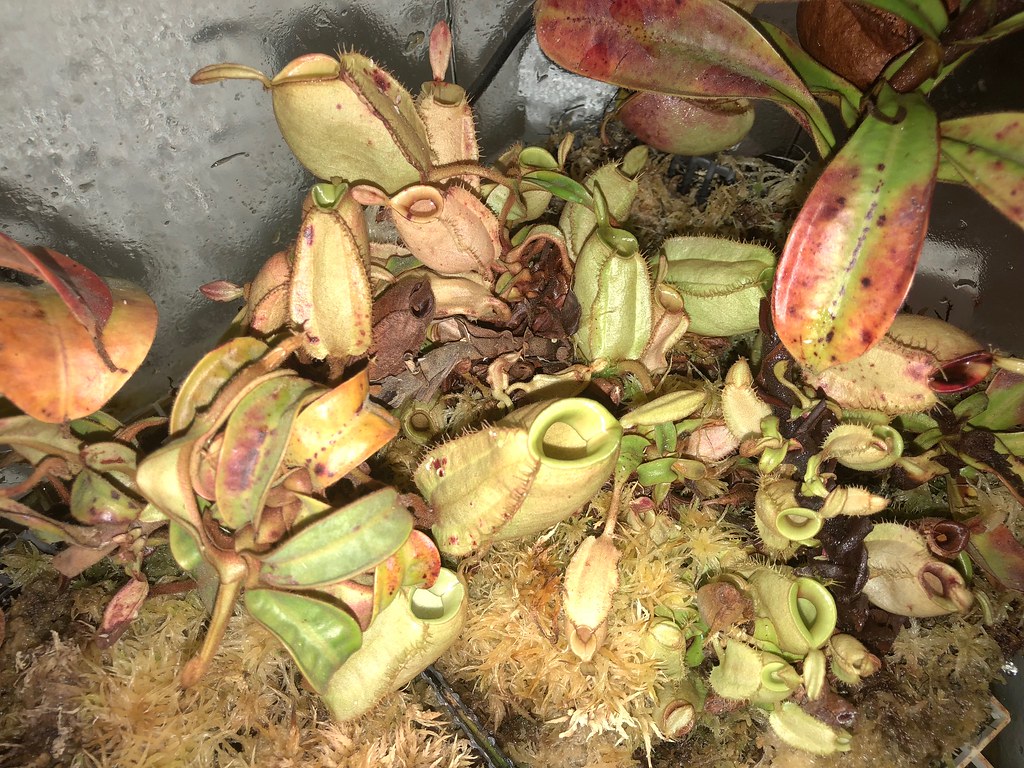
Nepenthes ampullaria terrarium Nepenthes ampullaria terrarium

The Nepenthes ampullaria and N. hookeriana terrarium was also tidied up, with the plants repotted into fresh mix. I also reduced the wattage of the lamp, replacing the 20W downlight with a 12W LED light bulb. The green form N. ampullaria responded by putting up a large pitcher a few days ago, so all good so far.
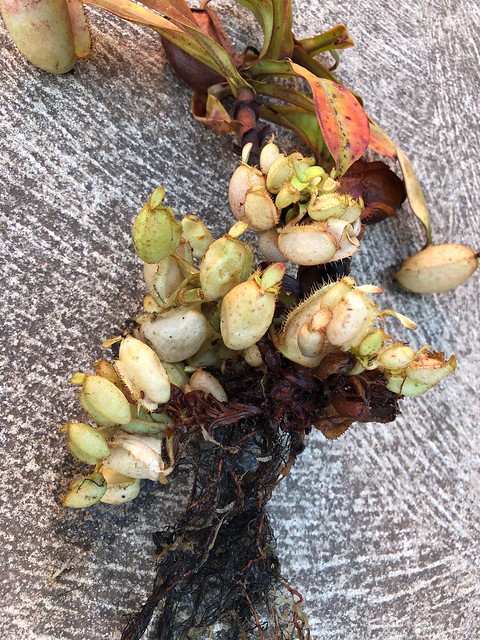
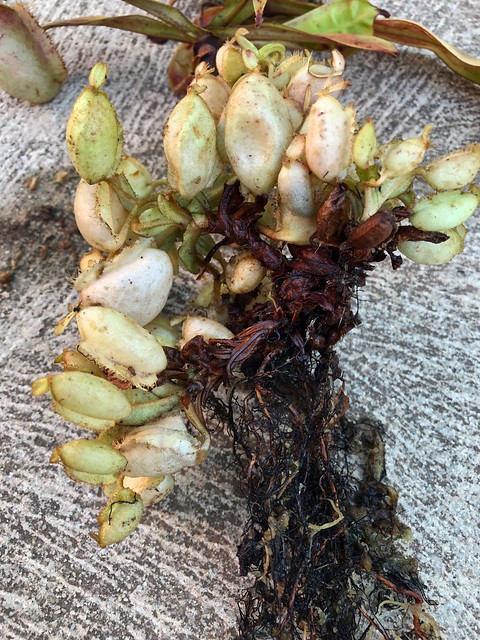
Cultivated Nepenthes ampullaria showing habit of basal pitcher production Cultivated Nepenthes ampullaria showing habit of basal pitcher production

Here’s how the green clone looked when de-potted. Note how the basal rosettes attach to the rhizome.

On the Sarracenia flava front, its repotting time. I’ve long been wondering why my flava var. rubricorpora have not been very red, and I’ve put it down to recycling peat from the bog 3 seasons ago (which would make it 6 seasons old – no wonder they weren’t happy!). I’m experimenting with a new formula of 2 peat: 1 sand: 1 scoria: 1 chopped pine needles. I’ve only managed one pot so far due to unexpected rain today, but the mix looks and feels very good. I’m hoping the scoria will help aerate the media more than using just peat, and am also hoping the pine needles will help reduce the amount of peat needed. Next time, I’ll put aside the pine needles and compost them for a full year before using it. I’m very interested in the peat-free mixes the UK growers are now using – the issue here is that the only remotely suitable material has lime added to it to increase pH, making it unsuitable for use in CP mixes (except Nepenthes – the mix I refer to is an orchid bark that I’ve used for them before with great results).

Collector’s corner display, Melbourne International Flower and Garden Show.Collector’s corner display, Melbourne International Flower and Garden Show.

I also managed to make it to Melbourne for the flower show a few weeks ago. Collector’s Corner had an impressive display with numerous CPs.

Pillar of Sarracenia x courtii; Collector’s corner display, Melbourne International Flower and Garden Show. Nepenthes x dyeriana; Collector’s corner display, Melbourne International Flower and Garden Show.

They even had a mound made entirely of S. x courtii (left)! At right is a N. x dyeriana.

Triffid Park’s display at the Melbourne International Flower Show, 2019Triffid Park’s display at the Melbourne International Flower Show, 2019Triffid Park’s display at the Melbourne International Flower Show, 2019

Triffid Park also had an impressive display too, with some beautiful Sarracenia. It was great to also have an opportunity to spend some time talking with Donna and Jason.

Red-Bodied Swallowtail (Pachliopta polydoras queenslandicus); Melbourne Zoo Butterfly House, Victoria, Australia.

And I even made it to the Melbourne Zoo, where I added a butterfly to my twitch list – the Red Bodied Swallowtail (Pachliopta polydoras queenslandicus). Its one of the few swallowtails in Australia I had not seen alive (the others being the alpine Graphium macleayanum and O. priamus macalpinei).

Cairns Birdwing (Ornithoptera euphorion); Melbourne Zoo Butterfly House, Victoria, Australia.

To close, here’s a male Cairns Birdwing butterfly (Ornithoptera euphorion), also in the Melbourne Zoo’s butterfly house.

Saturday, October 6, 2018

Rise of the Sarracenia flowers, a second try at Drosera schizandra and the Nepenthes ampullaria terrarium

Sarracenia flower buds rising, 2018-2019 season

The Sarracenia are preparing for another beautiful show of flowers. I did a quick head count this morning – 263 buds emerged and rising – which makes for a bumper year. The first flower looks to be about two weeks out still. I’m thinking of getting the pollination brushes out and doing some crosses. To make it easy, the plan is to self everything. Fortunately, the leucophylla almost always open up after the flava are done, so the chance of interspecies hybridisation is low.

Drosera schizandra terraria Drosera schizandra in coffee jar terrarium Drosera schizandra in a coffee jar terrarium

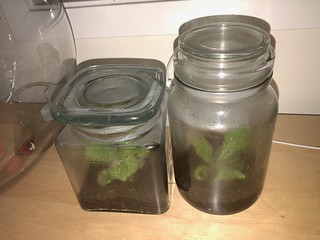
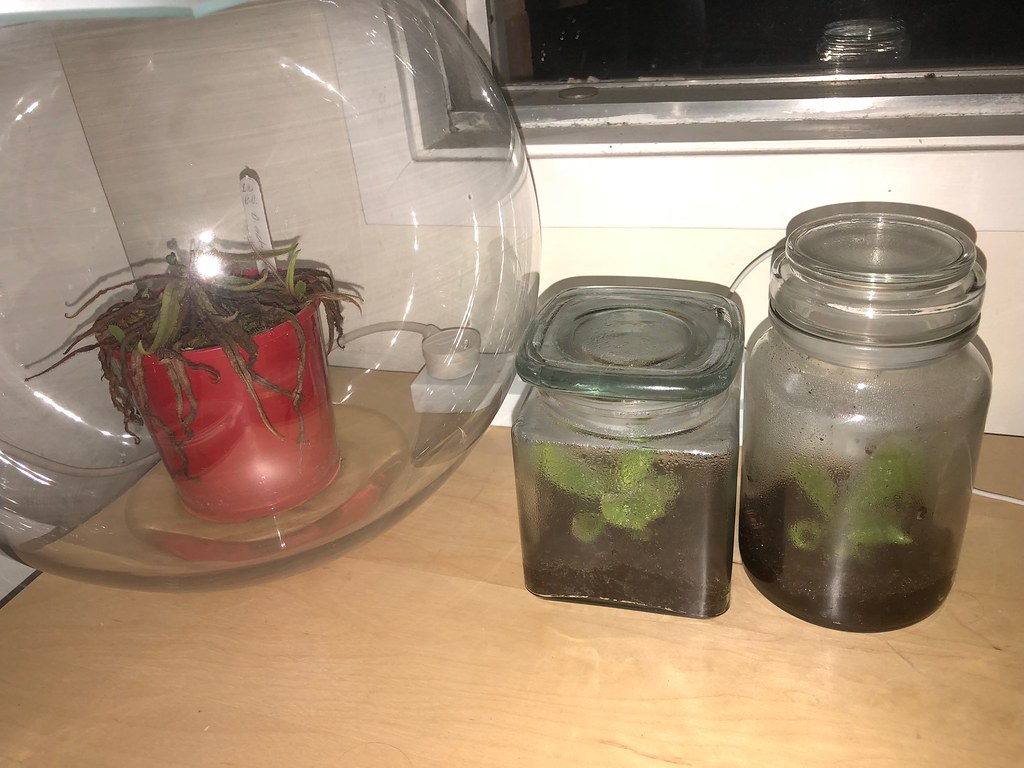
Last night was the October AUSCPS Canberra ground meeting, which had an emphasis on Pinguicula. I had an unexpected score – Dave Colburn from Sydney brought down some Drosera schizandra, a long-time favourite of mine and a plant I’ve only had the chance to try once. I currently have two coffee jar terrariums on my desk, getting indirect light through a north-facing window (southern hemisphere, so sun is to the north) and each growing a decent sized plant. Another AUSCPS member here grows D. schizandra to very large size, so I will have to take a look at his growing conditions.

On a sad note, the friend who accompanied me to try and find D. schizandra in the wild – Bob Miller – passed away a couple of months back. He was a very good friend who will be sorely missed.

Terraria for two of the Three Sisters - Drosera adelae & Drosera schizandra

Next to the D. schizandra is a large bowl holding a pot of D. adelae. The D. adeale are not especially happy (the spot they thrived last summer is not available at the moment) but that they are alive is still cause for celebration – I have lost D. adelae to the cold most years I’ve been in Canberra. Lack of light seems to be the problem (but I’m hoping this means there will be enough light to make D. schizandra happy). If it can hang in there a bit longer, it will get its old spot back and hopefully thrive again.

Terrarium grown Nepenthes ampullaria

There is another terrarium in my office, and it contains one plant each of Nepenthes ampullaria ‘green’, N. ampullaria ‘red’ (not that it gets very red!) and N. x hookeriana. The plants are doing very well, but the light has consistently been burning their leaves (and has bleached out the Sphagnum!). That said, both the N. ampullaria have been producing ground rosette pitchers, some aerial rosettes and decent sized lower pitchers. The light I’ve been using is a 20W LED floodlight producing 2000 lumens, mounted 20 cm above the plants. I’m now thinking of trying either a 15W floodlight (but the local Bunnings are out of stock), a 24W compact fluoro (which has worked for me before) or two of the Ikea grow lamps. All of these options get me to about 1400-1600 lumens, which should help reduce leaf burn. The plants grow above a heated water bath, which produces if anything too much humidity (the pots are too wet and I don’t water them – I just top up the water bath). I might need to put down a coir basket liner under the pots to trap more of the humidity in the water bath while I’m messing with the lights.